The Vital Importance of Industrial Mixers
By Billie Lorraine Adams, Ph D, JBW Systems, Inc.
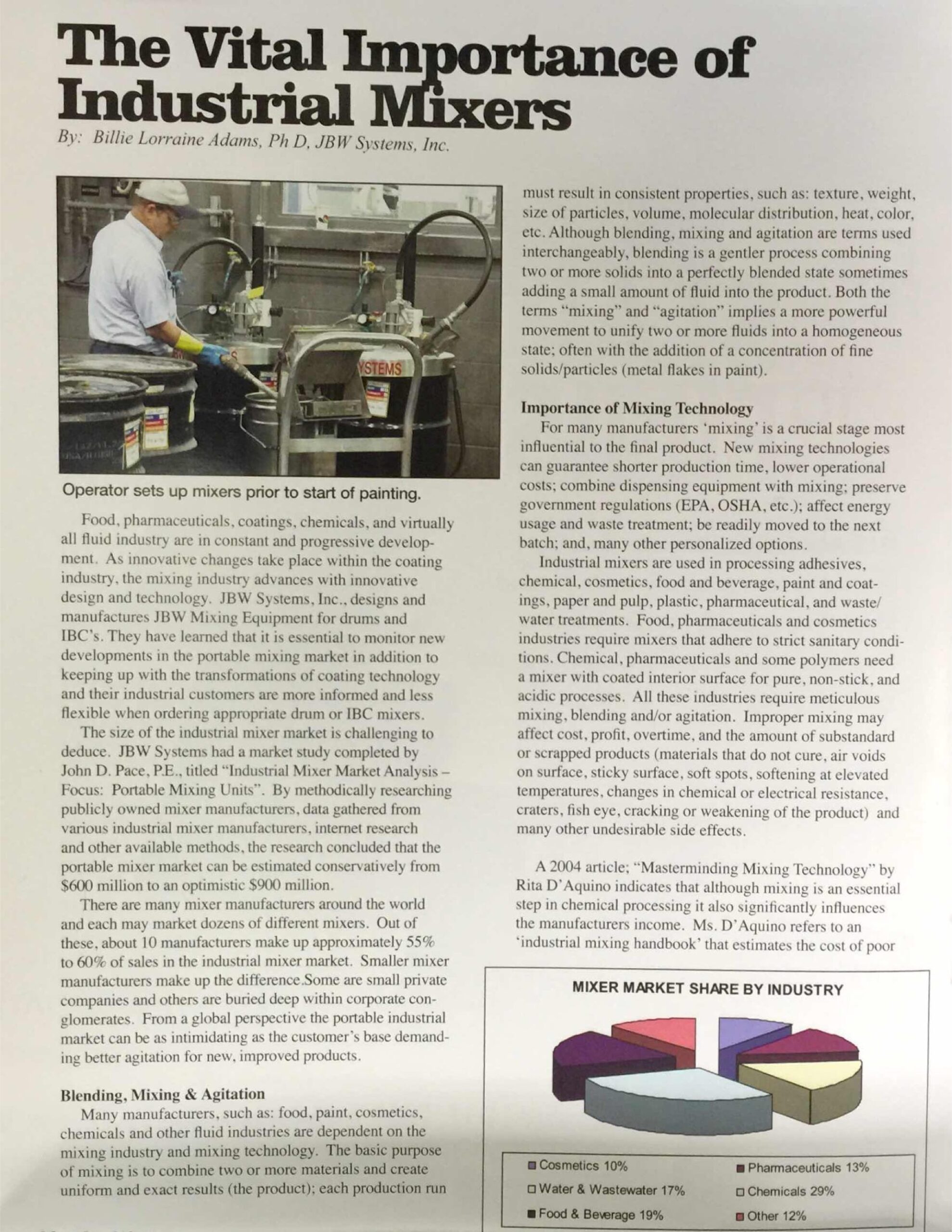
Food, pharmaceuticals, coatings, chemicals, and virtually all fluid industry are in constant and progressive development. As innovative changes take place within the coating industry, the mixing industry advances with innovative design and technology. JBW Systems, Inc., designs and manufactures JBW Mixing Equipment for drums and IBC’s. They have learned that it is essential to monitor new developments in the portable mixing market in addition to keeping up with the transformations of coating technology and their industrial customers are more informed and less flexible when ordering appropriate drum or IBC mixers.
The size of the industrial mixer market is challenging to deduce. JBW Systems had a market study completed by John D. Pace, P.E., titled “Industrial Mixer Market Analysis – Focus: Portable Mixing Units”. By methodically researching publicly owned mixer manufacturers, data gathered from various industrial mixer manufacturers, internet research and other available methods, the research concluded that the portable mixer market can be estimated conservatively from $600 million to an optimistic $900 million.
There are many mixer manufacturers around the world and each may market dozens of different mixers. Out of these, about 10 manufacturers make up approximately 55% to 60% of sales in the industrial mixer market. Smaller mixer manufacturers make up the difference. Some are small private companies and others are buried deep within corporate conglomerates. From a global perspective the portable industrial market can be as intimidating as the customer’s base demanding better agitation for new, improved products.
Blending, Mixing & Agitation
Many manufacturers, such as: food, paint, cosmetics, chemicals and other fluid industries are dependent on the mixing industry and mixing technology. The basic purpose of mixing is to combine two or more materials and create uniform and exact results (the product); each production run must result in consistent properties, such as: texture, weight, size of particles, volume, molecular distribution, heat, color, etc. Although blending, mixing and agitation are terms used interchangeably, blending is a gentler process combining two or more solids into a perfectly blended state sometimes adding a small amount of fluid into the product. Both the terms “mixing” and “agitation” implies a more powerful movement to unify two or more fluids into a homogeneous state; often with the addition of a concentration of fine solids/particles (metal flakes in paint).
Importance of Mixing Technology
For many manufacturers ‘mixing’ is a crucial stage most influential to the final product. New mixing technologies can guarantee shorter production time, lower operational costs; combine dispensing equipment with mixing; preserve government regulations (EPA, OSHA, etc.); affect energy usage and waste treatment; be readily moved to the next batch; and, many other personalized options.
Industrial mixers are used in processing adhesives, chemical, cosmetics, food and beverage, paint and coatings, paper and pulp, plastic, pharmaceutical, and waste/water treatments. Food, pharmaceuticals and cosmetics industries require mixers that adhere to strict sanitary conditions. Chemical, pharmaceuticals and some polymers need a mixer with coated interior surface for pure, non-stick, and acidic processes. All these industries require meticulous mixing, blending and/or agitation. Improper mixing may affect cost, profit, overtime, and the amount of substandard or scrapped products (materials that do not cure, air voids on surface, sticky spots, soft spots, softening at elevated temperatures, changes in chemical or electrical resistance, craters, fish eye, cracking or weakening of the product) and many other undesirable side effects.
A 2004 article; “Masterminding Mixing Technology” by Rita D’Aquino indicates that although mixing is an essential step in chemical processing it also significantly influences the manufacturers income. Ms. D’Aquino refers to an ‘industrial mixing handbook’ that estimates the cost of poor mixing to be $100 million annually in the U.S. alone.
Mixing equipment can no longer be considered an inconsequential component in production; not when faced with rising costs of energy and raw materials, government regulations, taxes, and other demands of industry. Mixing performance is crucial for improved, consistent products with exact standards. Any component that gives one a competitive edge is crucial.
Types of Industrial Mixing
Some industries use ‘batch’ mixing which is normally a very simple process. Materials are added to a container; the ‘batch’ is mixed completely. Afterward the product is sent to a different stage of production. When finished with the current batch, the mixer is made ready for the next ‘batch’ either quickly or days later. Another form of mixing is ‘continuous’ when the container continuously has material added to it and the fluid is agitated continuously and the end product is taken out or discharged. A continuous mixer runs for long periods of time and is used for mixtures that thicken or solidify upon dormant periods.
Organizing the numerous variations of mixers can be daunting and depending on each individual source has conflicting types of mixers. Basically there are four categories:
Blenders: These are made to blend bulk solids with other solids; in the sub-classes below:
• Convective blenders: Paddle blender, Ribbon blender and Vertical Screw blenders, which transfers heat by movement.
• Tumbler blenders: Double-cone blender, V-shape-blender, and Slant-blender, which use upstream or down stream air to blend.
• Fluidization blenders: Plow Mixer, Double Paddle Mixer. They moves solids as if they were liquids.
Agitators: Mix fluids with other fluids, sometimes dispersing gases into liquids, heat transfer, and suspension of solids in liquids by using rotating impellers, classed as follows:
• Axial Flow Impellers: These impellers are angled less than 90 degrees creating a flow parallel to the impeller shaft. (examples are boat propellers and pitched-blade turbine)
• Radial Flow Impellers: This type impeller blade discharges the flow along the impeller radius in very distinct patterns. The blades are parallel to the axis of the impeller. (examples are paddle, flat-blade turbine and anchor)
Heavy-Duty Mixers: (high viscosity mixers); these mixers are used for paste-type and viscous material (adhesives, gums, resins, putty, dough, etc.) and adapt to material with variable viscosity changes. They include the following:
• Double Arm Mixers
• Dual & Triple Shaft Mixers
• Planetary Mixers: they use two mixing blades rotating around separate shafts with the two blades also rotating around a center axis. This creates an inner-mix and shearing of the material.
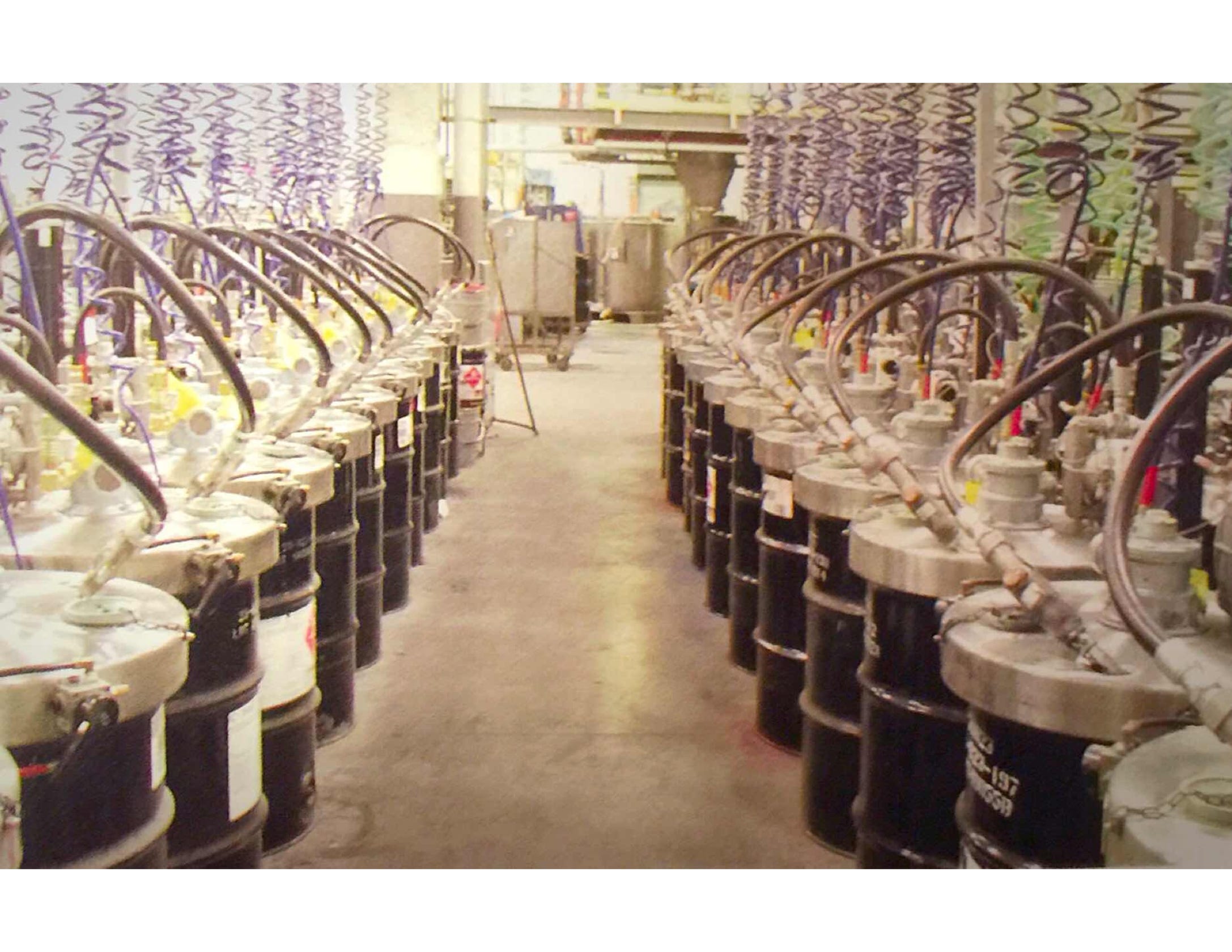
Portable Industrial Mixers: These mixers are diverse and offer unique and individualistic mixing methods to keep up with the challenges of the changing coating industry. Portable mixers are downsized and used in laboratories, in R&D, and up-scaled for use in major production. Portable mixers are used most commonly in drum containers and IBC’s.
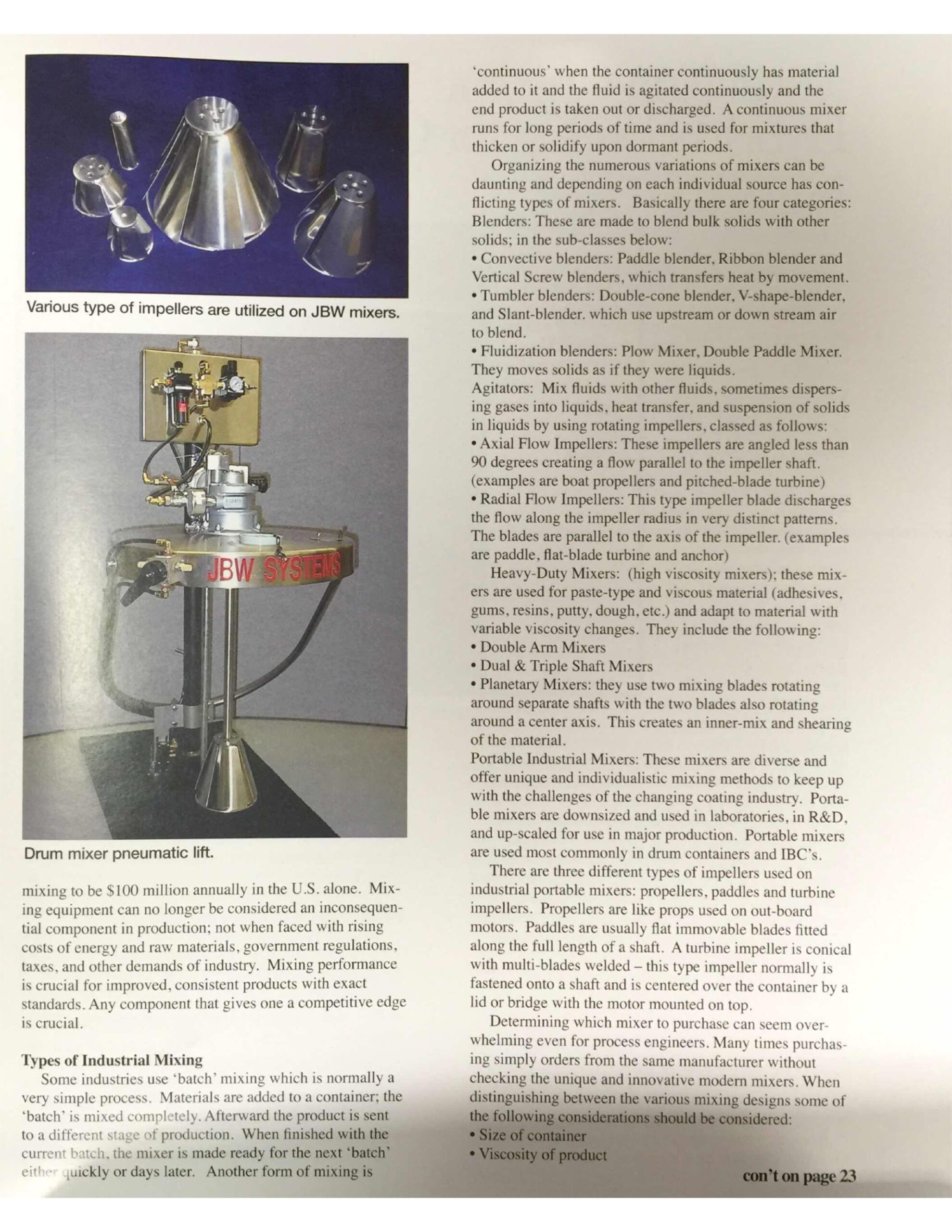
There are three different types of impellers used on industrial portable mixers: propellers, paddles and turbine impellers. Propellers are like props used on out-board motors. Paddles are usually flat immovable blades fitted along the full length of a shaft. A turbine impeller is conical with multi-blades welded – this type impeller normally is fastened onto a shaft and is centered over the container by a lid or bridge with the motor mounted on top.
Determining which mixer to purchase can seem overwhelming even for process engineers. Many times purchasing simply orders from the same manufacturer without checking the unique and innovative modern mixers. When distinguishing between the various mixing designs some of the following considerations should be considered:
• Size of container
• Viscosity of product